Physics × Computation × Data × Uncertainty
PhyAnalytics
Physics-Informed Analytics for Physical Systems
Physical modelling, scientific computing and uncertainty-aware analytics for complex physical systems.
Quantitative foundation
Four disciplines, one analysis
01
Physics
Governing principles, conservation laws and domain constraints that any credible model must respect.
02
Computation
Numerical methods, simulation and scientific computing, with verified accuracy.
03
Data
Inference from measurements, observations and computational results.
04
Uncertainty
Confidence, sensitivity, limitations and risk, stated alongside every result.
A quantitative result is incomplete without an understanding of its uncertainty.
Core capabilities
Physics-informed analytics
- 01 /
Model Calibration
Infer uncertain model parameters from observations.
- 02 /
Surrogate Modelling
Construct efficient approximations of computationally expensive models.
- 03 /
Data Assimilation
Combine observations with physical and computational models.
- 04 /
Anomaly Detection
Identify behaviour inconsistent with expected physical or statistical patterns.
- 05 /
Experimental Design
Use quantitative information to guide measurement and experimentation.
- 06 /
Uncertainty Quantification
Characterise confidence, sensitivity and uncertainty in quantitative results.
- 07 /
Risk-Informed Decisions
Connect quantitative predictions and uncertainty with decision-making.
Selected work
Evidence, not claims
CASE / 001
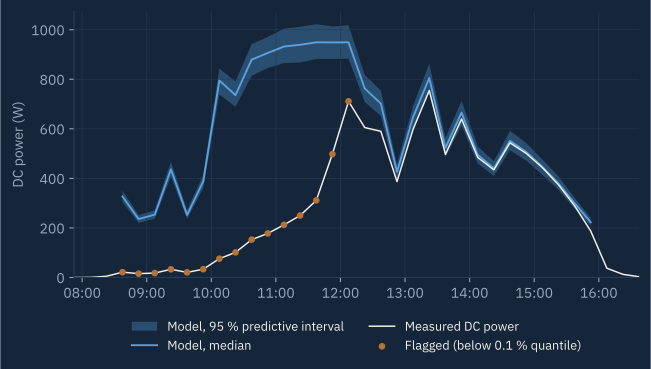
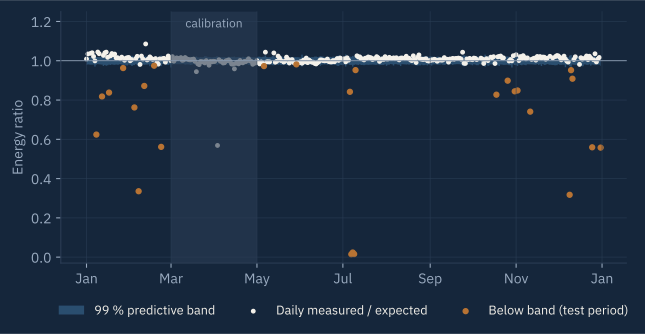
Detecting under-performance in a solar array with a calibrated physical model
A year of measured output from a 1 kW heterojunction silicon array, compared interval by interval with a Bayesian-calibrated physical model. Faults are flagged only when they fall outside the model's own predictive uncertainty.
- Data
- 11,177 fifteen-minute intervals, 361 days
- Calibrated on
- March–April only
- Temperature coefficient
- -0.299 %/°C [-0.317, -0.283]
- Days lost to major faults
- 5 with less than half the expected energy
NOTE / 001
Reporting a result with its uncertainty
Why a measured value without an interval is incomplete, and how to propagate input uncertainty through a model, using a pendulum measurement of g as the worked example.
Applications
Where the methods apply
Physical Systems
Physics-informed modelling and quantitative analysis of real systems: thermal, mechanical, electrical and nuclear.
Scientific Research
Numerical and computational investigation of physical problems, with calibrated models and stated uncertainty.
Physical Industry
Energy, water, mining and power grids: systems where physical understanding and reliability matter.
Education and Assessment
Physics assessment with worked solutions and topic-level performance analysis.
Explore assessmentAbout
How PhyAnalytics works
Each problem is approached the same way: understand the physical system, formulate a model, compute it accurately, confront it with data, quantify what remains uncertain, and only then interpret.
Problem → Model → Computation → Data → Uncertainty → Interpretation
About PhyAnalytics